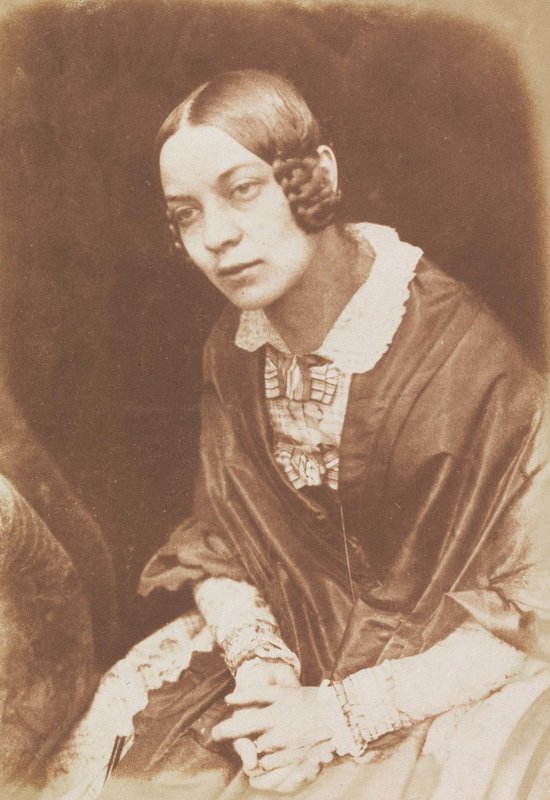
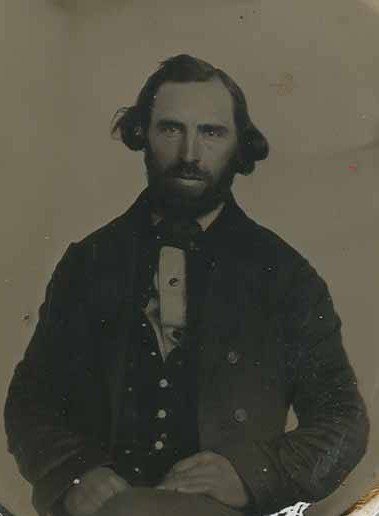
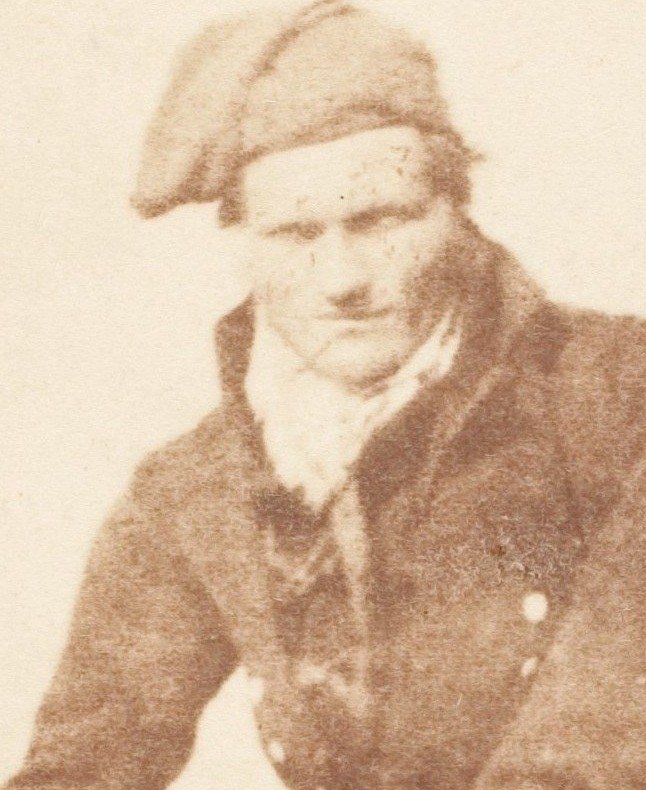
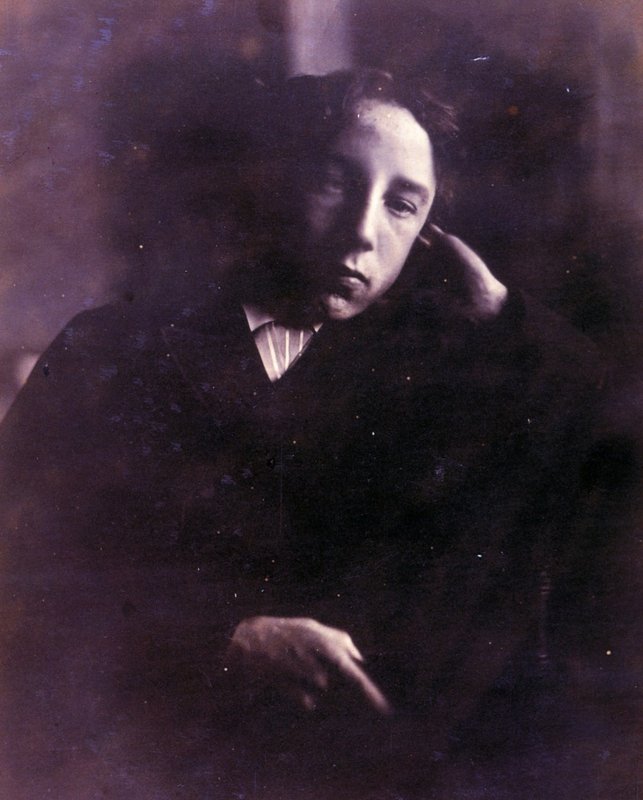
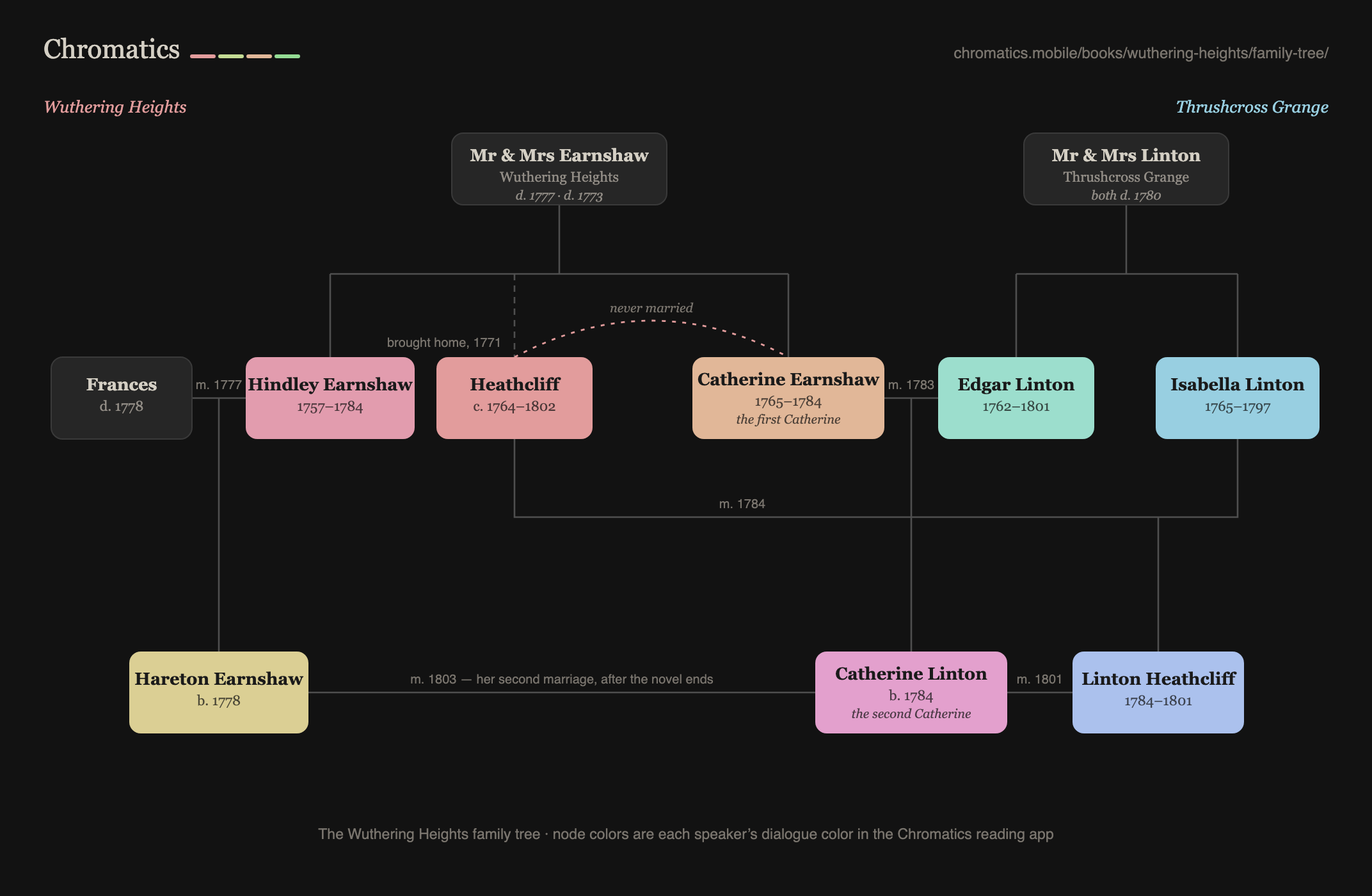
Two houses, two generations, two Catherines, and a foundling who marries into one family to ruin the other. Here is the whole genealogy with dates — each person filled with the dialogue color they keep in Chromatics from the first page to the last.
Tap or click a face for the photograph and that person’s own words.
Mr & Mrs Earnshawd. 1777 · d. 1773Wuthering Heights
Mr & Mrs Lintonboth d. 1780Thrushcross Grange
Francesd. 1778
m. 1783
m. 1783
m. 1802
m. 1801
Mr & Mrs Earnshawd. 1777 · d. 1773Wuthering Heights
Mr & Mrs Lintonboth d. 1780Thrushcross Grange
Francesd. 1778
marriage
· descent
· quotations verbatim from the 1847 text
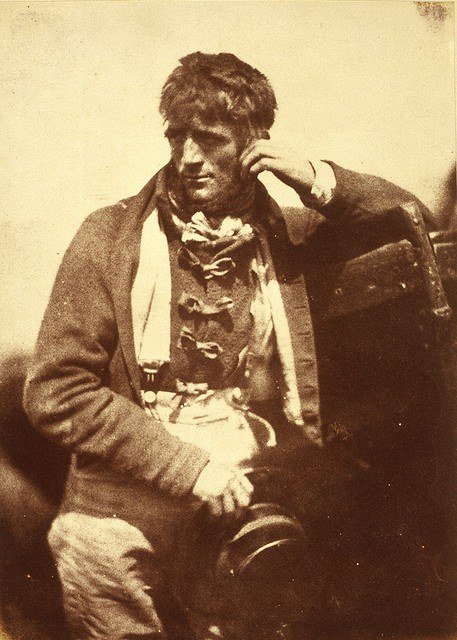
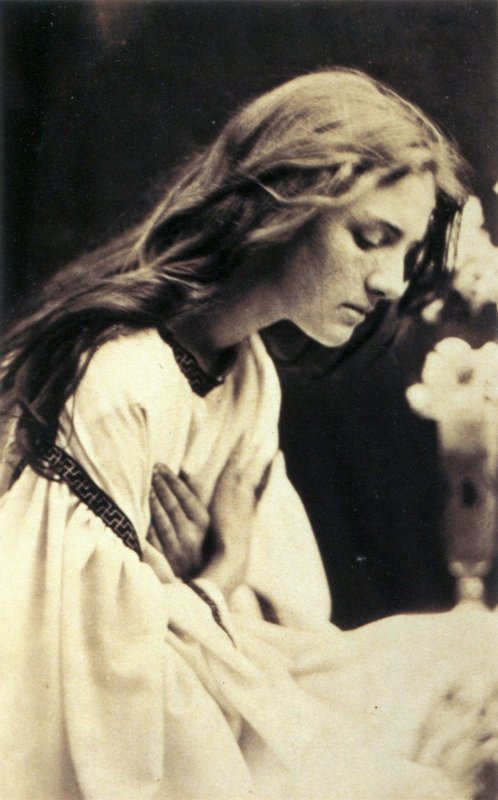
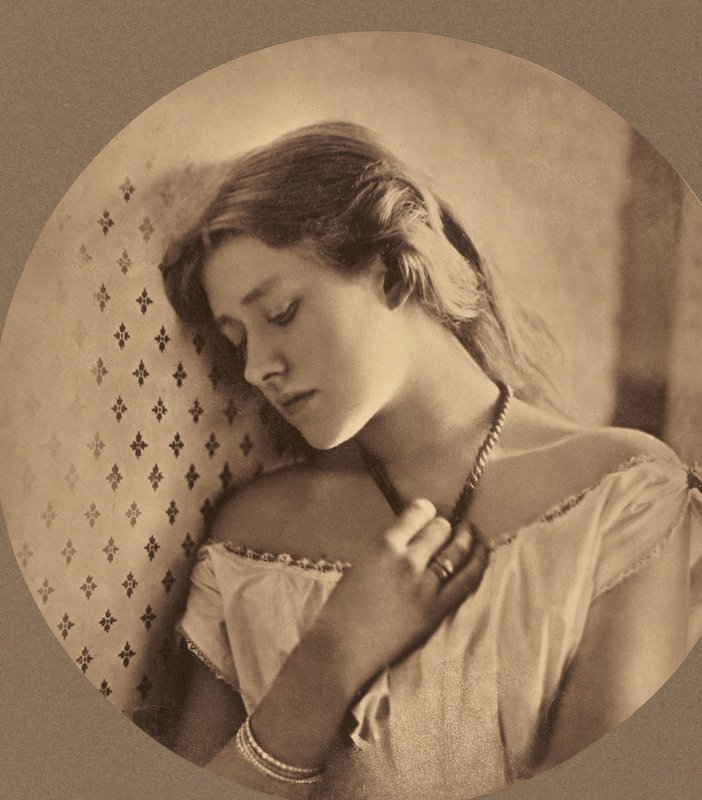
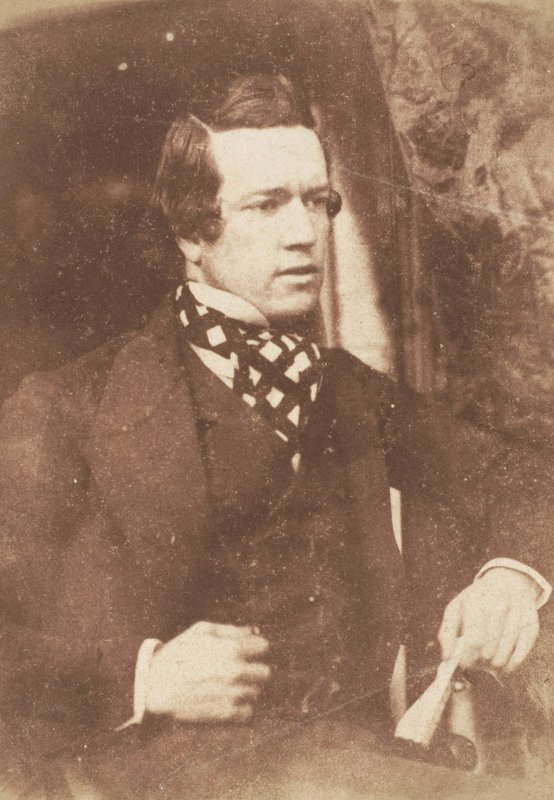
Photographs: Hill & Adamson · Julia Margaret Cameron · an unrecorded ambrotypist — the Metropolitan Museum of Art, the Getty, Yale Center for British Art and other open collections.
Hill & Adamson, 1843–47
Heathcliff
c. 1764–1802
Brought back from Liverpool by Mr Earnshaw in 1771 and raised alongside his children. Married Isabella Linton in 1783.
“Be with me always—take any form—drive me mad! only do not leave me in this abyss, where I cannot find you!”
Julia Margaret Cameron, 1865
Catherine Earnshaw
1765–1784
The elder Earnshaw daughter. Married Edgar Linton in 1783.
“My rival, as she will have herself to be, would shoot a shaft into your soul that would fix you for ever, and send my image into eternal oblivion!”
Ellen Terry, aged sixteen · Julia Margaret Cameron, 1864
Catherine Linton
b. 1784
Daughter of Catherine Earnshaw and Edgar Linton. Married Linton Heathcliff in 1801, and Hareton Earnshaw after.
“Mr. Heathcliff, you have nobody to love you… You are miserable, are you not? Lonely, like the devil, and envious like him? Nobody loves you—nobody will cry for you when you die!”
Dr Foulis · Hill & Adamson, 1843–47
Edgar Linton
1762–1801
The Linton son, master of Thrushcross Grange. Married Catherine Earnshaw in 1783.
“Will you give up Heathcliff hereafter, or will you give up me? It is impossible for you to be my friend and his at the same time; and I absolutely require to know which you choose.”
Miss Matilda Rigby · David Octavius Hill, 1845
Isabella Linton
1765–1797
The Linton daughter. Married Heathcliff in 1783.
“Is Mr. Heathcliff a man? If so, is he mad? And if not, is he a devil?”
Delos Waterman · ambrotype, c. 1856–58
Hindley Earnshaw
1757–1784
The Earnshaw son and heir. Married Frances; father of Hareton.
“Kiss me, Hareton! Damn thee, kiss me! By God, as if I would rear such a monster! As sure as I’m living, I’ll break the brat’s neck.”
Hill & Adamson, 1843–47 · detail
Hareton Earnshaw
b. 1778
Son of Hindley Earnshaw and Frances. The last Earnshaw.
“My name is Hareton Earnshaw, and I’d counsel you to respect it!”
Henry Herschel Hay Cameron, aged fifteen · Julia Margaret Cameron, 1867
Linton Heathcliff
1784–1801
Son of Heathcliff and Isabella Linton. Married Catherine Linton in 1801.
“No—don’t kiss me: it takes my breath… Will you shut the door, if you please? you left it open; and those—those detestable creatures won’t bring coals to the fire. It’s so cold!”
In Chromatics every person on this tree keeps their color on every page — the novel is free in full right now, and you will never flip back here.
Catherine Earnshaw is the first: Hindley’s sister, Heathcliff’s other half, Edgar’s wife. She is born at Wuthering Heights in 1765, becomes Catherine Linton by marriage in 1783, and dies in March 1784, two hours after giving birth.
Catherine Linton is the second: her daughter, called Cathy. She is born a Linton, becomes Catherine Heathcliff by her first marriage, and ends as Catherine Earnshaw by her second — her mother’s name, walked backwards. Lockwood finds all three names scratched into the windowsill in Chapter III and has no idea what he is looking at. Neither does anyone else on a first read.
There are two Heathcliffs as well: Heathcliff the foundling, and Linton Heathcliff, his son by Isabella. The recycled names are not carelessness — Emily Brontë is closing a circle. But she makes you work for it.
Wuth. Hts · Why you got lost
Why this book confuses everyone
Three reasons. First, the names: two Catherines, two Heathcliffs, and a Linton who is a person as well as two people’s surname. Second, the structure: the story reaches you through Lockwood, who hears most of it from Nelly, who heard parts of it from Isabella, Cathy, and Zillah — a narrator inside a narrator, with the timeline folded in half. Third, the dates matter and the book rarely states them; the chronology above was reconstructed from internal evidence, and the novel expects you to hold it in your head.
In Chromatics, two of the three problems dissolve on their own: every speaker keeps one color for the whole novel, so the two Catherines are never the same person on the page — and a quiet banner above the text tells you where you are, when it is, and who is telling the story to whom. The third problem is the one this page is for.
Wuth. Hts · The record
Everyone on the tree, in order of appearance in the registry
Mr and Mrs Earnshaw
Of Wuthering Heights. Parents of Hindley and Catherine; Mr Earnshaw carries Heathcliff home from Liverpool in 1771 and favors him ever after. Mrs Earnshaw dies in 1773, Mr Earnshaw in October 1777.
“Why canst thou not always be a good lass, Cathy?” — Chapter V
Mr and Mrs Linton
Of Thrushcross Grange. Parents of Edgar and Isabella. They take Catherine in after the dog bites her in 1780, and both die of the fever she brings into the house that same year.
Hindley Earnshaw · rose in the app
1757–1784. Catherine’s brother, master of the Heights after his father. Widowed in 1778, he drinks the estate into Heathcliff’s hands and dies six months after his sister.
“Kiss me, Hareton! Damn thee, kiss me! By God, as if I would rear such a monster!” — Chapter IX
Frances Earnshaw
Hindley’s wife, of origins he declines to explain. Dies of consumption in late 1778, soon after Hareton’s birth. She speaks too rarely in the novel to have earned a color in the app — the registry is honest about who talks.
Heathcliff · red in the app
c. 1764–1802. First name, last name, whole name. Found starving in Liverpool, brought home in 1771, degraded by Hindley, gone three years, and back with money no one dares ask about. Marries Isabella in 1784 to get at Edgar; by 1801 he owns both houses.
“Be with me always — take any form — drive me mad! only do not leave me in this abyss, where I cannot find you!” — Chapter XVI
Catherine Earnshaw, later Linton · vermilion in the app · the first Catherine
1765–1784. Marries Edgar in 1783 because it would degrade her to marry Heathcliff, and never recovers from her own decision. Dies on 20 March 1784, two hours after her daughter is born.
“Nelly, I am Heathcliff! He’s always, always in my mind.” — Chapter IX
Edgar Linton · teal in the app
1762–1801. Master of the Grange, Catherine’s husband, Cathy’s father. Patient in a book where patience is not a survival trait. Dies in September 1801, weeks after his daughter is forced into her first marriage.
“Will you give up Heathcliff hereafter, or will you give up me?” — Chapter XI
Isabella Linton, later Heathcliff · cyan in the app
1765–1797. Edgar’s sister. Elopes with Heathcliff in January 1784 against every warning available, flees him within months, and raises their son alone in the south until her death.
“Is Mr. Heathcliff a man? If so, is he mad? And if not, is he a devil?” — Chapter XIII, in a letter to Nelly
Hareton Earnshaw · amber in the app
Born June 1778, son of Hindley and Frances. Dispossessed by Heathcliff and raised rough, then slowly unrough. His marriage to Cathy — planned for 1 January 1803, just past the last page — returns the Heights to an Earnshaw, which is where the carving over the door came in.
“I’ll go to hell, body and soul, before I look sideways after you again!” — Chapter XXXII
Catherine Linton, later Heathcliff, later Earnshaw · magenta in the app · the second Catherine
Born 20 March 1784, daughter of Catherine and Edgar. Called Cathy. Forced to marry the dying Linton Heathcliff in August 1801; widowed by October; engaged to Hareton by the end.
“Come, you shall take notice of me, Hareton: you are my cousin, and you shall own me.” — Chapter XXXII
Linton Heathcliff · blue in the app
September 1784 – October 1801. Son of Heathcliff and Isabella; the second Heathcliff. Peevish, frail, and used by his father as the instrument for taking the Grange. Married to Cathy for roughly ten weeks.
“It’s mine: papa says everything she has is mine.” — Chapter XXVIII
Wuth. Hts · The household tells it
And the people telling you all this
None of the family narrates. The story arrives through the household — and they have colors too.
Nelly Dean · housekeeper, chief narrator · green
Mr. Lockwood · tenant, audience · olive
Joseph · servant, Yorkshire scripture · indigo
When the nesting gets deep — Cathy telling Nelly, who is telling Lockwood, who is telling you — the app’s scene banner keeps the chain in view: Wuth. Hts · Cathy → Nelly → Lock. · Past 3 weeks. There is more about that, and a page you can listen to, on the Wuthering Heights audiobook page; the book itself lives on its hub page.
Wuth. Hts · Asked and answered
Quick answers
How are the two Catherines related?
Mother and daughter. Catherine Earnshaw is the first — Heathcliff’s Catherine, Edgar’s wife. Catherine Linton, called Cathy, is her daughter, born the day her mother died. The full untangling is above.
Is Heathcliff related to the Earnshaws by blood?
No — a foundling carried home from Liverpool in 1771 and raised alongside Catherine and Hindley. Catherine grew up as his near-sister, which is part of what scandalized the book’s first readers.
How is Hareton related to Heathcliff?
Not by blood at all: Hareton is Hindley’s son. Heathcliff raises him rough and unlettered on purpose — doing to Hindley’s child exactly what Hindley did to him. The symmetry is the point.
Who does Cathy marry?
Twice over: Linton Heathcliff, forced, in August 1801 — widowed in about ten weeks — and then Hareton Earnshaw, freely, with the wedding set for New Year’s Day 1803, just past the last page.
Why do the names repeat?
Because Emily Brontë is closing a circle: the second generation carries the first’s names through the same two houses and walks the damage backwards. It is confusing on purpose — and it rewards exactly one careful look at the tree above.
Wuth. Hts · Your shelf · Tonight
Every one of these people keeps their color for the whole novel — you will never need this page again. Read it that way, free.