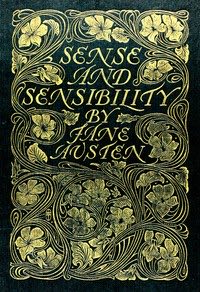
S&S · Jane Austen · 1811
Sense and Sensibility
Two sisters, one inheritance whittled to nothing in a single conversation, and the question the title asks: do you survive on judgment or on feeling? It was Austen’s first published novel — she signed it only “By a Lady” — and the machinery is already perfect: people saying one thing, meaning another, and revealing everything by how they say it. This fall it’s about to be everywhere: a new film adaptation arrives in theaters October 2026. The book is better company first — and it’s featured in Chromatics now, free in full, every voice in one steady color, with Karen Savage’s recording reading along.
Your commonplace book · Sense and Sensibility · 3 lines
“Know your own happiness. You want nothing but patience — or give it a more fascinating name, call it hope.” Mrs. Dashwood · Ch. 19
“It is not every one who has your passion for dead leaves.” Elinor, to Marianne · Ch. 16
“I wish as well as every body else to be perfectly happy; but, like every body else it must be in my own way.” Elinor · Ch. 17
The film · October 2026
Before the movie fills in the faces
The new adaptation — directed by Georgia Oakley, with Daisy Edgar-Jones as Elinor, Esmé Creed-Miles as Marianne, George MacKay as Edward, Frank Dillane as Willoughby, and Herbert Nordrum as Colonel Brandon — reaches U.K. theaters September 25 and U.S. theaters October 16, 2026. The full book-to-film casting is mapped on the characters page. Every Austen reader knows what happens next: for a year, the film’s Elinor is Elinor. There is a short window, right now, to meet the sisters on the page first — to hear Marianne’s raptures and Elinor’s dry replies in your own head before someone else’s casting does it for you.
The novel is featured now — free in full — on the app’s Now a Major Motion Picture shelf — alongside Wuthering Heights and Frankenstein, this year’s other returns to the screen.
On the page · Who is speaking
Austen is a playwright in disguise
Whole chapters of Sense and Sensibility are nearly stage dialogue — long exchanges with barely a “said Elinor” to steer by, where the joke depends entirely on knowing who is being polite at whom. That’s the confusion Chromatics was built for: each voice holds one color from first page to last, the scene banner keeps you placed at Norland or Barton or London, and when a line stops you — Austen produces one every few pages — you keep it, attributed to its speaker, in her color, forever.
October 1811 · “By a Lady”
The debut nobody signed
The title page of the first edition names no author — just “BY A LADY.” Austen was thirty-five, had been writing this book in one form or another since her early twenties (it began as “Elinor and Marianne,” a novel in letters), and she took the cautious road to print: publication on commission, meaning she — not the publisher — bore the cost and the risk of failure. She reportedly set money aside against the expected loss. Instead the first edition sold out by the summer of 1813 and earned her about £140 — the first money she ever made, at an age when the marriage market the novel dissects had already closed its books on her. She kept the secret so well that most of her acquaintance never knew; the follow-up was signed only “by the author of Sense and Sensibility.” The follow-up was Pride and Prejudice.
There is something exactly right, given what this novel is about, in the fact that we know its author’s earnings to the pound: Austen kept her accounts the way her characters keep theirs — precisely, and without illusions.
The open questions · Pick a side
What readers still fight about
Does the book punish Marianne? The case that it does: she is the most alive person in it, and her story arcs from rapture to public humiliation to near-fatal fever to marriage with a grave older man she once ruled out on grounds of age and flannel waistcoats — while the narrator calls Delaford her “reward.” Generations of readers have felt the ending as a sentence handed down: feel less, marry sensibly, live. The counter-case is in the final chapter’s most careful sentence — “her whole heart became, in time, as much devoted to her husband, as it had once been to Willoughby” — as much: Austen’s claim is not that Marianne settled but that the seventeen-year-old’s one-love-per-lifetime rule was the actual cage. Note, too, the detail the ledger turns up: Brandon’s income is exactly the “competence” Marianne named as her minimum. Either Austen is winking that the romantic was a materialist all along, or the marriage is the one bargain in the book where the money and the feeling finally agree. Both readings survive contact with the text, which is why the fight is two centuries old.
And which sister is the book actually for? The title reads like a verdict — sense good, sensibility dangerous — and Marianne’s fever seems to sign it. But watch what Elinor’s sense buys her: months of silent misery, a secret kept so well it nearly costs her Edward, and the novel’s one real breakdown — her cry when the engagement finally dissolves is the loudest feeling in the book. Meanwhile the characters who perform each virtue are the frauds: Willoughby performs sensibility right up until the accounting, and Fanny Dashwood performs sense while committing the book’s coldest act in chapter two. Austen’s target was never feeling; it was theater. The title is a false binary she spends fifty chapters dismantling — and the sisters end the book having traded a measure of each other’s virtue, which is as close as Austen comes to a moral.
Your shelf · Nearby
Elsewhere on the shelf
The characters, the money, and the audiobook each have their own page. If it’s the wit you come for, Pride and Prejudice is one shelf over in the app. If it’s the yearning, Wuthering Heights will raise the temperature considerably — its family tree is the other famous confusion the colors untangle. And every line you keep can live on in your own Notion workspace or your Readwise review.
Read it before October. The whole novel, colors and banner included, free while featured.
Start reading freeFree on iPhone and iPad. On Android? Leave an email.