Gatsby · Long Island · Summer 1922
East Egg vs. West Egg in The Great Gatsby, explained
Two peninsulas on Long Island, identical in shape and opposite in everything else. Gatsby’s whole tragedy lives in the courtesy bay between them. Here is what the eggs actually are, which one is old money, where the new money came from, the real places Fitzgerald drew them from — and the argument readers have been having about the two shores for a hundred years.
The geographyOld vs. new moneyWhere new money came fromThe green lightThe real placesThe argumentQuick answers
West Egg · Nick · Summer 1922
The geography, first
The eggs are two real-looking spits of land jutting north into Long Island Sound, twenty miles from Manhattan, separated by a narrow inlet Nick calls a courtesy bay. From above they are twins — not perfect ovals but, “like the egg in the Columbus story,” crushed flat at the contact end. From the ground they could not be less alike. West Egg — where Nick rents his small house and Gatsby owns his enormous one — is the “less fashionable” side, though Nick calls that “a most superficial tag to express the bizarre and not a little sinister contrast between them.” East Egg, glittering white across the water, is where the Buchanans live. Same shape, opposite worlds.
Twenty miles from the city a pair of enormous eggs, identical in contour and separated only by a courtesy bay, jut out into … the great wet barnyard of Long Island Sound. … To the wingless a more interesting phenomenon is their dissimilarity in every particular except shape and size.
I lived at West Egg, the—well, the less fashionable of the two. … Across the courtesy bay the white palaces of fashionable East Egg glittered along the water.
Gatsby · The thing the bay is made of
Old money, new money
The bay is not really water. It is time. East Egg is old money — wealth inherited, generations deep, so settled it no longer has to try. Tom Buchanan brought a string of polo ponies east because that is simply what a Buchanan does. West Egg is new money — loud, recent, self-made and a little gaudy, wealth that still has the price tag on it. Gatsby’s mansion is a “factual imitation of some Hôtel de Ville in Normandy,” which is exactly the tell: East Egg is the thing; West Egg imitates it. You can buy a house on the right peninsula. You cannot buy your way across the courtesy bay, and the novel is the story of a man who refuses to believe that.
| West Egg | East Egg | |
|---|---|---|
| The money | New — made, recently, and not always legally | Old — inherited, generations deep |
| The houses | Gatsby’s “factual imitation of some Hôtel de Ville in Normandy,” tower and all, next to Nick’s $80-a-month cottage | The Buchanans’ “cheerful red-and-white Georgian Colonial mansion,” and the “white palaces” along the shore |
| Who lives there | Gatsby, Nick — and, historically, the show-business rich | Tom and Daisy Buchanan, the Sloanes, “staid nobility” |
| The parties | Hundreds of uninvited strangers under Gatsby’s blue gardens, “men and girls… like moths” (Ch. III) | Small dinners, polo, “East Egg condescending to West Egg, and carefully on guard against its spectroscopic gayety” (Ch. III) |
| The manners | Trying — Gatsby’s “old sport,” rehearsed and slightly off | Effortless — and effortlessly cruel; Tom’s “Mr. Nobody from Nowhere” (Ch. VII) |
| Real-life model | Great Neck, where Fitzgerald lived 1922–24 | Sands Point & Port Washington, across Manhasset Bay |
| How it ends | Gatsby face-down in the pool; the parties over | Untouched — the Buchanans “retreated back into their money” |
The novel itself is free in Chromatics right now — the whole text, the audiobook synced to the page, and both shores kept straight for you while you read.
Gatsby · Who lives where
The two shores, and the ashes between
East Egg — old money
- Tom Buchananinherited wealth, New Haven, polo ponies The egg made flesh: rich from birth, certain of everything, threatened by a man who arrived from nowhere.
- Daisy BuchananNick’s cousin; Gatsby’s green light The golden girl on the far shore, the prize Gatsby bought the West Egg mansion to be near. Her voice, Gatsby decides, is “full of money.”
West Egg — new money
- Jay Gatsbyborn James Gatz; “old sport” Self-invented, self-made, self-named. Throws the parties, owns the mansion, reaches across the bay every night.
- Nick Carrawaythe narrator; Gatsby’s neighbour Rents the small eyesore next door to Gatsby — “the consoling proximity of millionaires” for eighty dollars a month. Born to the East-Egg world, living in West Egg, watching both — and the app, by pure hue-arithmetic, gives him and East Egg the same olive. An accident the novel would have approved of.
The valley of ashes — between
- Myrtle WilsonTom’s mistress; the garage Neither egg — the grey industrial flat between West Egg and the city, where the road and the railway pass.
- George Wilsonher husband; the garage owner The one man the bay never lets up, watched over by the faded eyes of Doctor T. J. Eckleburg.
The dots are the dialogue colors each speaker keeps in the app, as the book renders today — one hue per voice, first page to last.
The valley itself gets the novel’s second-most-famous description: “a fantastic farm where ashes grow like wheat into ridges and hills and grotesque gardens” (Ch. II). Every trip between the eggs and Manhattan — by car or by train — passes through it, which is the design: the rich of both eggs commute daily over the people their money burns, under a billboard’s enormous painted eyes.
1922 · Where the fortunes came from
Where new money came from — and why it read as gauche
The eggs only make sense against the money of their moment. Old money in 1922 meant the Gilded Age fortunes — railroads, banking, steel, oil — two or three generations laundered into respectability: trusts, Yale, polo, and above all the code that wealth should be quiet. When everyone you dine with is rich, display proves nothing; understatement is the flex. Tom’s Georgian Colonial doesn’t announce itself, because it doesn’t have to.
New money was minted faster and stranger. The war had made industrial fortunes overnight; the bull market was making paper millionaires by the week; Broadway and the infant movie business were paying entertainers sums no farmer’s son had ever seen; and Prohibition — two years old as the novel opens — had just created the most lucrative black market in American history. Gatsby’s money is that last kind: the “drug-stores” Tom finally throws in his face at the Plaza were bootlegging fronts, and everyone at the table knows it. New money had no choice about display — visibility was the whole proof of arrival. The pink suit, the yellow car Tom sneers at as a “circus wagon,” a shirt for every week of the year sent over from England each spring: it is money that must be seen to exist at all. Which is exactly why old money found it vulgar — and why the vulgarity is the most honest thing in the book. Gatsby’s display at least admits what it wants. Tom’s restraint conceals what he does.
The sorting was real on the real North Shore, too: Great Neck — West Egg — was where the show-business and newspaper money settled, while the Guggenheims and their peers held the old estates across the bay. Fitzgerald didn’t invent the geography; he moved into it, rented at the bottom of it, and took notes.
Daisy’s dock · Night · One shore away
The green light between them
The bay would be only a metaphor if Fitzgerald hadn’t given it a point of light. At the end of Chapter I, Nick watches his neighbour stretch out his arms toward the dark water — toward “a single green light, minute and far away, that might have been the end of a dock.” It is the end of a dock: Daisy’s dock, in East Egg, directly across the courtesy bay from Gatsby’s lawn. Everything the two eggs mean is compressed into that geometry — close enough to see every night, unreachable by any bridge money can build. The novel’s last page widens it to everyone: “Gatsby believed in the green light, the orgastic future that year by year recedes before us.” The eggs are a map of that sentence.
Plaza Hotel · Nick · Summer 1922
The whole divide, in one room
It takes the hottest afternoon of the year and a suite at the Plaza for the bay to finally speak out loud. Tom has spent seven chapters being unfailingly, poisonously polite about his wife’s new friend; here the manners finally fail, and what comes out — Mr. Nobody from Nowhere — is the courtesy bay in four words. Notice what Tom attacks: not the affair, first, but the origin. Where the money came from is the insult; the wife is almost incidental.
“What kind of a row are you trying to cause in my house anyhow?”
“He isn’t causing a row,” Daisy looked desperately from one to the other. “You’re causing a row. Please have a little self-control.”
“Self-control!” repeated Tom incredulously. “I suppose the latest thing is to sit back and let Mr. Nobody from Nowhere make love to your wife. … Well, if that’s the idea you can count me out.”
Gatsby · The real eggs · Long Island, actually
The real places behind the eggs
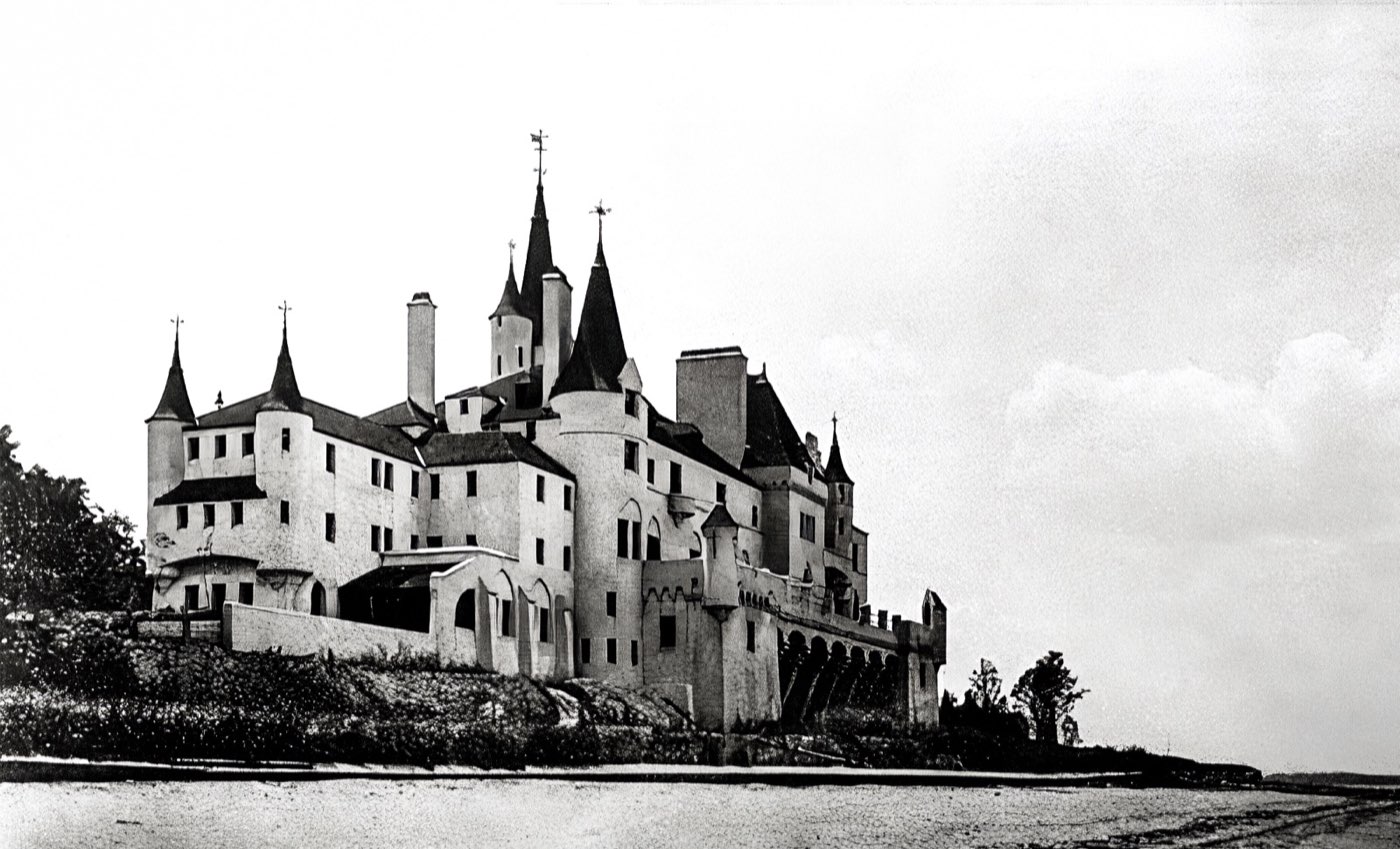
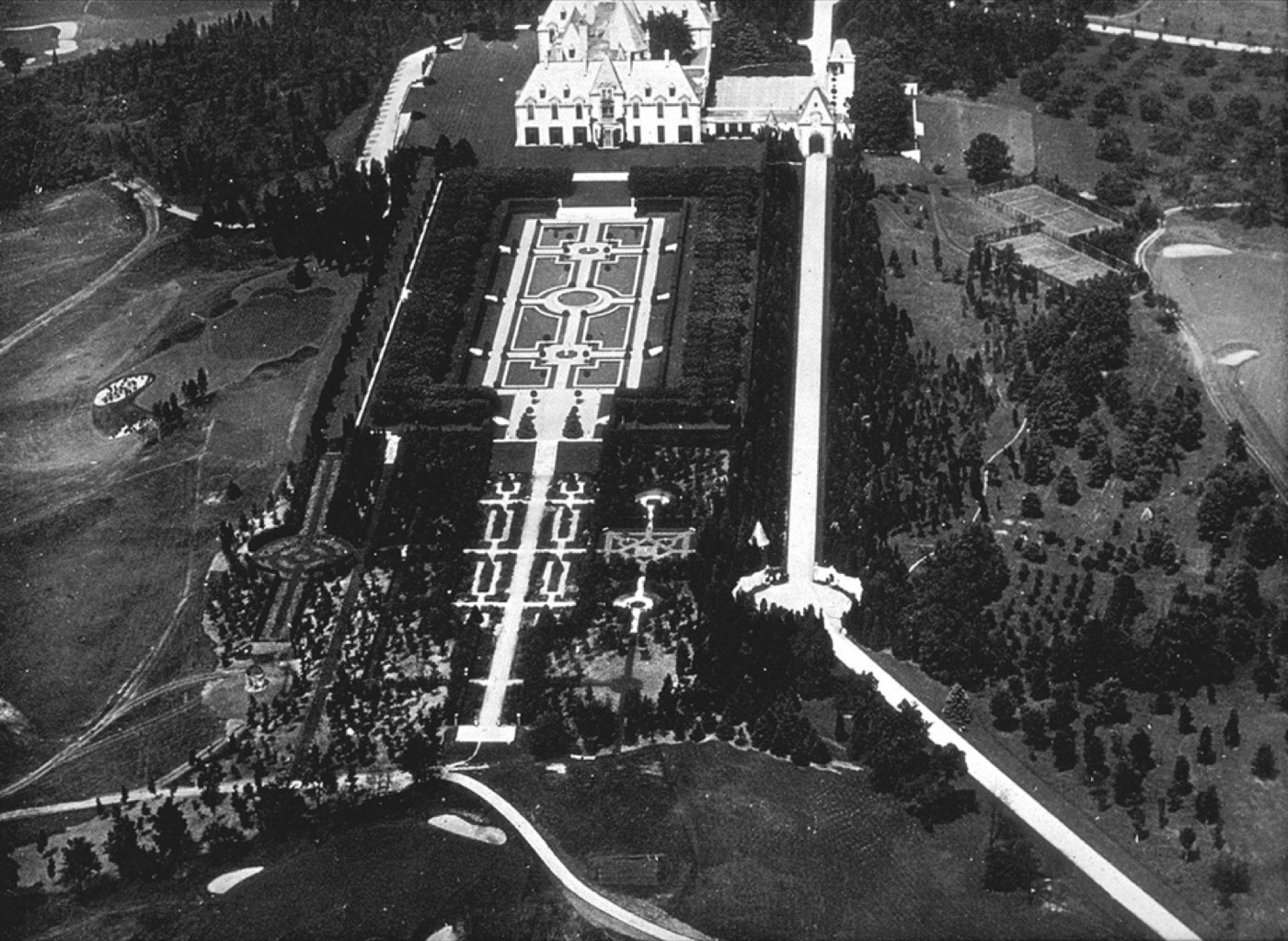
The eggs are lightly fictionalized, not invented. From October 1922 to the spring of 1924 the Fitzgeralds rented a house at 6 Gateway Drive in Great Neck, on Long Island’s North Shore, and Great Neck is universally taken as the model for West Egg. It was exactly the novel’s kind of place: the new commuter colony of freshly made show-business and newspaper money — Ring Lardner across the way, Herbert Bayard Swope throwing the all-weekend parties that guests wandered into uninvited, half of Broadway within a mile of the station. Fitzgerald was renting at the bottom of a millionaires’ colony on new-money money of his own; Nick’s eighty-dollar cottage is the house key to the whole book.
Across the water sat the older, statelier Cow Neck peninsula — Sands Point and Port Washington — the standing identification for East Egg, its shoreline lined with the estates of Guggenheims and Astors. The mansion long pointed to as Daisy’s — Land’s End, at the peninsula’s tip — stood until 2011, when it was demolished for a subdivision, an ending Fitzgerald could have written. The “courtesy bay” between the two is Manhasset Bay — a stretch of water small enough to see across at night, which is all the plot requires of it.
The valley of ashes was real too: the Corona ash dumps in Queens, mountains of furnace ash and refuse along the road and railway into Manhattan — Fitzgerald rode past them on every train from Great Neck to Penn Station. In the 1930s the dumps were leveled to build the 1939 World’s Fair grounds; the site is now Flushing Meadows Corona Park. On a modern map, then: West Egg is Great Neck (its tip is Kings Point, where a Chrysler estate became the U.S. Merchant Marine Academy), East Egg is Sands Point, the bay between them is Manhasset Bay, and the valley of ashes hosts the U.S. Open. The eggs themselves are tidied into a matching pair for the symbol’s sake — geography edited until it means something.
A century of readers · Two camps
The argument about the eggs
The standard reading — the one on this page so far — treats the bay as moral geography: East Egg is the corrupt, sealed old order; West Egg is vulgar but alive, the American dream with the price tag still on. Nick says it himself, going home: West Egg’s failings are “a most superficial tag,” and by the last chapter he has picked a shore — Gatsby “turned out all right at the end.”
The counter-reading has been gaining for decades, and it is worth taking seriously: the eggs are the same egg. Identical in contour is not a joke about geography — it is the thesis. Both shores are parasitic on the valley of ashes; both wreck the Wilsons between them (Tom takes Myrtle, Daisy kills her, Gatsby’s car is the weapon, George is aimed at Gatsby like a loaded gun someone else cocked); and neither shore attends the funeral. On this reading Nick — who assures us on page one that he is “inclined to reserve all judgments” and then judges everyone for nine chapters — is not the umpire but the third egg: old-family enough to be charmed, poor enough to feel superior about it. The famous last-chapter verdict, “they were careless people, Tom and Daisy,” is either the book’s moral or Nick’s final self-exoneration, depending on which camp you sit in.
Fitzgerald, for what it’s worth, refused to sit anywhere. He wrote the book from Great Neck, a new-money renter among new-money neighbors, homesick for an old-money respectability he also despised — “within and without, simultaneously enchanted and repelled,” as Nick says of himself at Myrtle’s party. The bay runs through the author. That is why the argument has lasted a hundred years, and why it is worth having again, with the text open. Read the last two pages of Chapter I — Gatsby’s arms out toward the light — then the last two pages of the novel, and decide which egg the book finally believes in. It can be done in an evening; the whole novel is five and a half hours read aloud.
Gatsby · Asked and answered
Quick answers
What is the difference between East Egg and West Egg?
Both are rich; the difference is the age of the money. East Egg is old, inherited wealth — the Buchanans. West Egg is new money — Gatsby’s side, wealth recently made and conspicuously spent. The peninsulas are identical in shape and separated only by a small bay, which is Fitzgerald’s point: the distance is social, not physical.
Are East Egg and West Egg real places?
Lightly fictionalized ones. West Egg is modeled on Great Neck, where Fitzgerald lived while writing the novel; East Egg on the Sands Point / Port Washington peninsula across Manhasset Bay. The full geography is above.
Does Gatsby live in East Egg or West Egg?
West Egg, with Nick next door. Tom and Daisy live across the bay in East Egg — which is why the green light at the end of Daisy’s dock is visible from Gatsby’s lawn, and why he bought that lawn in the first place.
What is the courtesy bay?
Nick’s phrase in Chapter I for the narrow inlet separating the two eggs. Its real-world counterpart is Manhasset Bay. “Courtesy” is doing quiet work: the eggs are neighbours by geography and strangers by choice.
Why are they called eggs?
Their shape from the air — “a pair of enormous eggs, identical in contour,” each, “like the egg in the Columbus story,” crushed flat at the contact end. East and West is simply which side of the bay each sits on.
Why does Nick live in West Egg?
Rent: eighty dollars a month for a weathered cottage wedged between mansions. But the placement is the novel’s neatest structural trick — Nick is old-family enough to dine in East Egg and poor enough to sleep in West Egg, the one narrator with a foot on each shore.
Your shelf · Nearby
Keep going
The book’s own page is here, the complete cast — every character on both shores, with quotes and colors — is on the characters page, and the read-along audiobook lets you hear Kara Shallenberg cross the bay aloud. For another book where a single steady colour does the work of a map, the Wuthering Heights family tree sorts out two houses on the moor, and the Crime and Punishment characters page untangles four names per Russian.
The Great Gatsby is featured now — the whole novel, both eggs colour-coded, audio included, free.
Start reading freeFree on iPhone and iPad. On Android? Leave an email.